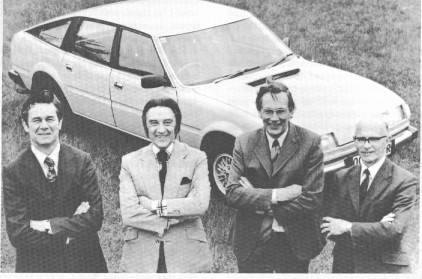
Mike Lewis, David Bache, Spen King und Gordon Bashford
mit ihrem Produkt; interessante Beschreibungen von Karen Pender s. unten
David Bache
David Bache trained at Birmingham University and College of Art, starting his motor
industry career as a student engineering apprentice at the Austin Motor Company.
One of his earliest projects here was the design of the instrument panel for the Austin
A30. There were so few competent designers in the Midlands at this time that he was
headhunted by Rover, and he joined the company in 1954. Sent to the Paris Motor
Show, he was profoundly influenced by the new Facel Vega. This model's sleek,
handsome lines were reflected in a series of Rover cars styled by Bache. The first
Rover car to be styled by David Bache was the three-litre P5, followed by the Mark II
Land Rover. However, his first important design was the Rover 2000, which carried
the unique sculptural stamp which characterized all of his work. His body design for
the gas-turbine Rover showed the successful combination of high style with compe-
tition aerodynamics. Later designs included the P6BS project and the Range Rover.
At the time of the SD1 project, David Bache was Rover's chief engineer of styling,
and was responsible for the car's unique shape - making sketches, silhouettes and
then having clay models produced. The whole SD1 project was a labour of love for
him. After SD1, he became Leyland Cars' director of styling, and later went on the
shape both the Metro and the Maestro models, retiring from the company in 1981.
He was once described as the most influential designer in the British Motor Industry.
David Bache died in 1994. Appropriately, there was a line-up of the Rover cars he
had styled outside the church at his funeral service
Charles Spencer (‘Spen') King joined Rolls-Royce at Derby as an engineering
apprentice during World War II. Here he became involved in the design and de-
velopment of jet engines, joining Rover in 1945 and working on the conception
of the Rover 'jet' cars - the gas-turbine cars - until 1961. He then moved over to
Rover's production cars, and was closely involved in the design of the
Rover 2000 (P6) range of cars. Spen King went on to mastermind the Range
Rover project, and together with Gordon Bash-ford, produced the P6BS coupe.
This car was a mid-engined sports car, and would have been produced by
Rover if the newly-formed British Leyland had not abandoned the project. He
was also involved with the development of the Triumph Dolomite Sprint and the
Triumph Stag. Spen King was director of engineering and product planning at
the time of the SD1 project. He was enthusiastic and had a 'hands-on' approach
to his work, and enjoyed sorting out problems in the development workshops.
When BL was broken up,  Spen moved on to BL Technology, which was set up
as an advanced engineering and manufacturing group. He left the company in
1985, to set up an engineering consultancy. He is regarded by many people as
one of the great chief engineers of all time. Spen King lives in Warwickshire,
and his hobbies include a passionate interest in sailing and also photography.
Mike Lewis joined the Rover company in 1954 as a graduate apprentice. He
joined the engineering department the following year, and worked on the torque
converter for a semi-automatic transmission for the P4 model. Mike Lewis joined
the company's research section when it was formed two years later, and was pro-
moted to chief research engineer in 1966. He was appointed chief engineer, new
vehicle projects, in 1971 with overall responsibility for the SD1. In autumn 1974,
before pre-production started, he was asked to hand over responsibility for en-
gineering SD1 to the current cars department and to take up a more senior
position in the emerging combined Rover-Triumph engineering department. It is
clear that the SD1 project formed a major part of his life. Later on, he was the
brains behind the formation of BL Technology. Nowadays, Mike Lewis lives in
Cornwall, and his hobbies include an interest in 'God's Wonderful Railway' —
the Great Western
Gordon Bashford had an incredibly long career with Rover. He contributed a
great deal to the marque, being involved in the design of all of Rover's models
from the 1930s to the SD1 of the 1970s. He joined the company in 1930,
straight after leaving school. A friend introduced him to Roland Seal, who was
at that time the head of the drawing office at Rover. Seal gave him a junior job
in the department paying the (then) princely sum of ten shillings a week. The
very first car Gordon Bashford was concerned with was the Scarab — an
advanced, rear-engined car. However, this project was eventually abandoned
and the Scarab was never put in to production. He became involved in the
design of the PI models - these cars acquired a good name for the company
during the war, when they were able to keep going with the minimum of main-
tenance. After his roles in designing both the P3 and P4 models, Gordon
Bashford was asked to tackle the layout of the Land Rover. He had no pre-
vious experience of designing four-wheel-drive vehicles, but got this task
just right - the basic Land Rover layout remains unchanged to this day. He
was also involved in the designs of the P5 and P6 models, and the P6BS
and P8 prototypes, and worked very closely with Spen King on both the
gas-turbine cars and the Range Rover. Gordon Bashford was responsible
for the SDl's design and he believed that there was a good deal to be said
for the model's live axle rear suspension system. After the SD1, he made
a substantial input to the chassis engineering of the Maestro. His hobby
was designing and building racing cars in his spare time. Gordon Bash-
ford retired from work in 1981, and died in 1991. He is fondly remembered
by all who knew him.